Being a goalie in soccer is a unique profession and one of the most challenging positions to play.
It would help if you found soccer goalie drills that combine the goalkeeping into your training sessions.
If you’re coaching a young team, it is possible that you don’t have a specific goalie on the team, and instead, all players rotate through the position.
Using soccer goalie drills will enable you to determine which of your players is fit for the role. That said, we have listed down ten soccer goalie drills you can use to incorporate goalkeeping into your training sessions:
Goalie Wars
Two goalkeepers compete against each other, trying to score in the other’s goal. Each goalkeeper can throw, kick, or drop-kick the ball at the other goalkeeper to score while the other goalkeeper attempts to save the ball.
Setup:
- Set up a 20×15 playing grid using cones. Make sure there is one cone on each sideline of the grid that marks the half waypoint.
- Set up a full-sized goal on each end line.
- Use a couple of cones to mark a line 5-yards in front of each goal. These two zones are known as the “goalie zones.” The cones should not be in the play’s way but should be easily seen for the goalkeepers to be aware of.
- One goalkeeper is needed in each of the goals. If there are extra goalkeepers, have them stand off to the side and retrieve any soccer balls that miss the goal. Rotate the goalkeepers after each round.
- An adequate supply of soccer balls is needed in each of the goals.
- Decide on a time, or score limit for each round and the number of rounds to be completed. 3-4 minutes per game or the first goalkeeper to score five goals is a good starting point. Play for 4-6 rounds.
- One goalkeeper starts with the soccer ball.
Variation:
- Best for younger goalkeepers. Use the same rules, but have teams of two goalkeepers compete against each other.
- Change the rules to keep the game new. Allow only kicking from the ground, throws, or any other scoring technique to make the game more challenging.
Execution:

- The goalkeeper with the ball stands inside their goalie zone while the other goalkeeper stands inside of theirs. The former will attempt to score by throwing, kicking, drop-kicking, or volleying the soccer ball towards the other goal. They must make their attempt inside of their goalie zone.
- The defending goalkeeper attempts to make a save on the shot before getting a chance to score on the other goalkeeper.
- If a goalkeeper scores, the goalkeeper who just scored gets to start with a new ball from their goal.
- If a goalkeeper blocks the shot and the ball goes out-of-bounds, the goalkeeper who made the save starts with a new ball from their goal.
- When the ball rolls back into the shooting goalkeeper’s half, he gets a one-touch shot attempt from anywhere inside their half. It doesn’t matter if the soccer ball hits off a goal post or the defending goalkeeper gives up a rebound, and
- The game continues in this manner for the remainder of the round.
- After the round is over, goalkeepers rest and collect any balls that missed the goal. If there are more than two goalkeepers, have them rotate in immediately and begin play. If there are only two goalkeepers present, give the goalkeepers 2-3 minutes of rest before starting the next round.
It is a fun and competitive match for goalkeepers that improve their footwork, reflexes, agility, distribution, and confidence. Goalkeepers get to play against each other in a high-intensity game.
Rapid Fire
Eight soccer balls are positioned at the end of the penalty box. Two players take turns shooting while one goalkeeper tries to block one shot after another in rapid succession.
Setup:
- One full-size goal.
- One goalkeeper is positioned in front of the goal.
- Two more goalkeepers, coaches, or players are required to be the shooters. If there are multiple goalkeepers, have them rotate positions after each set of eight soccer balls.
- Place eight soccer balls on the edge of the penalty box. If a penalty box is not being used, position the soccer balls about 18 yards away from the goal.
Variation:
- Depending on the goalkeeper’s age and skill level, increase, or decrease the number of shots per round. More shots per game will demand more fitness and increase the goalkeeper’s stamina.
- Change the angle or distance of the shots to make the goalkeepers work on different saves.
Execution:
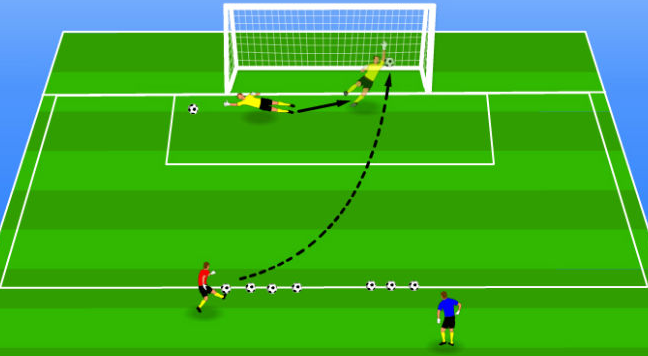
- To start the activity, one of the shooters takes a shot on goal while the goalkeeper attempts to save.
- As soon as the first shot is saved, or scored, the second shooter takes another shot.
- The shooters alternate taking shots until there are no more soccer balls left.
- The goalkeeper in goal must quickly react after each shot and move to attempt to save the next shot.
- After eight soccer balls have been shot, collect the soccer balls, and reset them on the penalty box line. If there is only one goalkeeper, give them plenty of rest time before repeating the same process for the next round. If there are multiple goalkeepers, have the next goalkeeper rotate in and repeat the process immediately.
- Repeat until each goalkeeper completes 3-4 rounds.
It helps develop a goalkeeper’s ability to quickly save one shot and bounce back swiftly and react to the next shot. Goalkeepers improve their footwork and reaction time.
Under Pressure
A goalkeeper starts from a goal kick and tries to play out the approaching defenders’ pressure when possible. The goalkeeper and four extra players attempt to pass out of the back, facing three defenders.
Setup:
- One half of the field can be used for the drill.
- One full-sized goal should be placed on the end line.
- Set up two cone gates on the half-line about 10-15 yards inside of each sideline. The cone gates should be 3-4 yards wide.
- Seven extra players are needed. Works best if these players are field players. Four players should be given matching colored vests and will be on the goalkeeper’s team. The other three players will be the defending team and should be given a different jersey color than the attacking team.
- Place a line of cones 15 yards off the edge of the penalty box. This will be the line the three defenders must start behind.
- The four players on the goalkeeper’s team should get into a 3-1 formation. This means three defenders are spread across the field’s width while one midfielder just in front of them.
- The goalkeeper starts with the ball inside the 6-yard box. All the extra soccer balls should be kept inside the goalkeeper’s goal.
Variation:
- Add, more or less, attackers or defenders. Switch up the numbers and numbers advantages.
Execution:
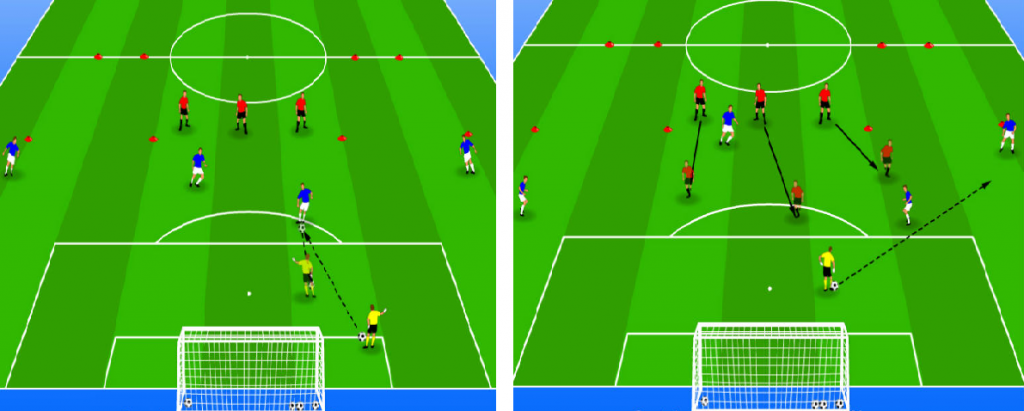
- The goalkeeper starts the drill by passing the ball to one of their teammates outside the penalty box.
- The receiving player passes the ball directly back to the goalkeeper.
- As soon as the receiving player touches the ball, the three defenders are free to move in front of their cone line and put them under pressure.
- The goalkeeper receives the ball from their teammate and attempts to pass and move with them to play out of the defender’s pressure. The goalkeeper and field players try to pass or dribble the ball through the two gates on the half-line.
- The three defenders move and attempt to steal the ball and score on the other team.
- If a goal is scored or the ball goes out-of-bounds, for either team, the players reset, and the goalkeeper restarts the activity with a goal kick.
- The process is repeated for 4-6 repetitions before goalkeepers rest or rotate positions. Field players should also switch roles every 4-6 repetitions.
- Each goalkeeper should complete two rounds.
It develops the goalkeeper’s confidence and feet when placed under pressure. Goalkeepers increase their touch and decision making when completing this activity.
Goalkeepers improve their ability to help their defenders play out of the opponent’s pressure and keep possession for their team.
Tip the Ball Over
A goalkeeper starts on the 6-yard line and attempts to backpedal and tip the thrown ball over the crossbar.
Setup:
- A full-sized goal is needed.
- One goalkeeper starts on the 6-yard line facing forward.
- One extra goalkeeper, player, or coach is needed as a server. The server stands about 12-15 yards away from the goal with an adequate supply of soccer balls.
- The server starts with one ball in their hands.
Variation:
- Adjust the goalkeeper’s starting point depending on the age and skill level of the goalkeepers. The further away from the goal, the more difficult the save.
Execution:
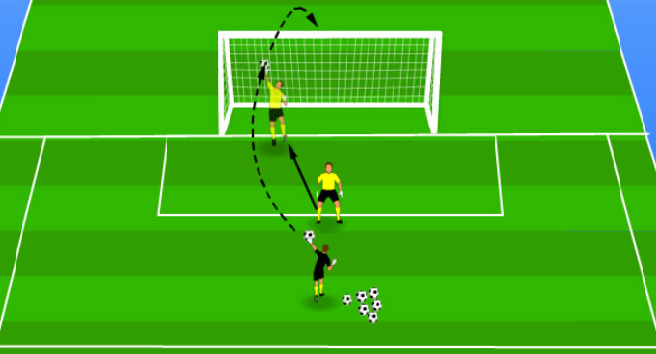
- The server starts the drill by throwing the ball over the goalkeeper and towards the goal in any direction. The server is aiming to get the ball to drop into the goal just below the crossbar.
- The goalkeeper must quickly move backward and time their jump to tip the ball over the crossbar.
- Immediately after landing, the goalkeeper pops up and returns to the 6-yard line to repeat the process.
- The server should throw the next ball as soon as the goalkeeper gets to the 6-yard line. The server should vary the location the ball is thrown (center, left, or right).
- The goalkeeper should complete 6-8 repetitions before resting and collecting the soccer balls.
- If there is more than one goalkeeper, have them rotate and complete the same process.
- Each goalkeeper should complete 2-3 rounds.
It develops a goalkeeper’s ability to recover backward and tip the ball over the crossbar when a catch is impossible. Improves the goalkeeper’s jumping and timing skills when recovering from being out of position.
Deflect and Drive
The goalkeeper is working attempts to block a low shot at one post before quickly getting up and moving across the goal to stop a high shot at the far post.
Setup:
- One full-size goal is needed for the drill.
- One goalkeeper starts on the goal line.
- Three extra players are needed as servers for this activity. If there are not three more goalkeepers, players or coaches can be used to fill in the remaining serving positions.
- Server #1 will start on the goal end line, 1-2 yards off on of the goalposts.
- Server #2 will be positioned inside the field, 6-8 yards off the opposite goal post of Server #1.
- Server #3 will stand inside the field, 8-9 yards away from the center of the goal.
- See the diagram for more information.
- Servers #1 and #3 must have an adequate supply of soccer balls.
- Decide on the number of soccer balls the goalkeeper will attempt to save before resting. 4-8 soccer balls are ideal.
Variation:
- Instead of throws, or light passes, move the servers further away from the goal and use their feet to shoot on goal—same pattern as listed above. Shooters should be aiming to put the ball in the same place as listed above as well. This makes the saves more game-like and forces goalkeepers to be faster and stronger on the blocks.
Execution:
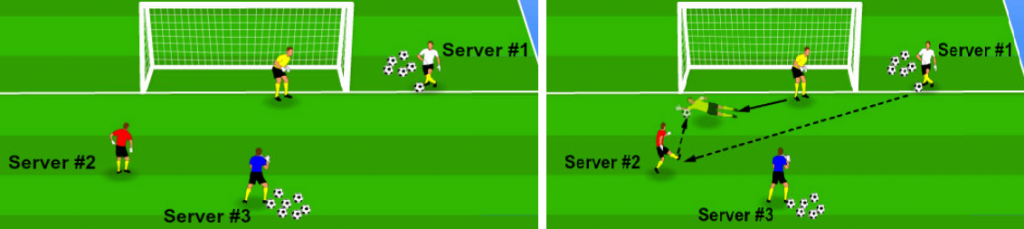
- Server #1 starts the drill with a low pass towards server #2.
- As the ball approaches server #2, the goalkeeper moves towards the receiver to cut off the scoring angles.
- Server #2 takes a low, one-touch shot while the goalkeeper attempts to block the shot using their hands or feet.
- Following the low shot, the goalkeeper should move towards the other post. Meanwhile, server #3 throws a ball high to the post the goalkeeper is moving towards. The goalkeeper dives and attempts to block or catch the ball.
- Depending on the age, fitness level, and available goalkeepers, give them a few seconds to reset before completing the process two to three times. If the goalkeepers are fit, provide them with no time to reset in-between repetitions. If multiple goalkeepers are present, keep the repetitions to 2-3 before quickly rotating in the next goalkeeper.
- Switch the sides the serves are on after a few rounds so that goalkeepers work on both ways.
- Each goalkeeper should complete 3-6 rounds. Complete more rounds if desired, or if the number of repetitions per game is short.
It helps develop goalkeepers’ ability to move back and forth across the goal to block shots. Goalkeepers improve their quickness and agility as they attempt to block shots.
Agility Hands
A goalkeeper works through a series of cones and sticks before attempting to catch soccer balls kicked at them from a short distance.
Setup:
- It is best to do this in front of a full-size goal for goalkeepers to get more comfortable with their boxes. Using a goal also keeps the soccer balls close in case a catch is missed. If a goal is unavailable, this drill can be completed without one.
- Set up a series of cones in front of the goal. See the diagrams below for different variations.
- Set up two mannequins, about 6-7 yards apart from each other, at the end of the cones series. If dummies are not available, cones can also be used.
- One goalkeeper starts on the goal line.
- Two extra goalkeepers, players, or coaches are needed as servers to complete this drill. Have the two servers stand 4-5 yards off each mannequin with a ball in their hands.
- Give each server 3-5 extra soccer balls.
Variation:
- Servers pass on the ground, and goalkeepers must pass the ball back to the servers in one-touch.
- Servers toss the ball high so the goalkeepers must jump up and catch the ball.
- Servers throw or pass the ball wide outside the mannequins to make the goalkeeper dive and collect it.
Execution:
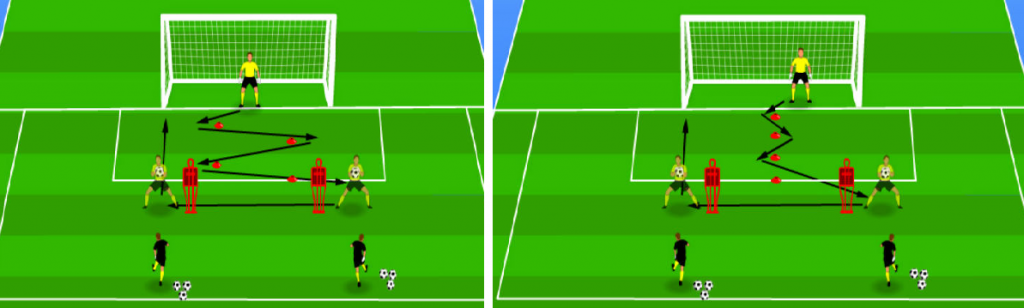
- The goalkeeper in front of the goal begins by quickly moving through the cones series.
- After completing the series of cones, the goalkeeper quickly moves to the outside of the nearest mannequin.
- As soon as the goalkeeper arrives outside the first mannequin, the server standing behind drop kicks the ball towards the goalkeeper’s chest.
- The goalkeeper will catch the ball and throw it back to the server before shuffling across to the other dummy. And then, they will repeat the drill.
- After throwing the ball back to the second server, the goalkeeper must use proper footwork to run back to the starting point. And then, they will repeat the process until they complete 8-12 catches.
- After the goalkeeper completes their round, rest and recover any lost soccer balls. If there is more than one goalkeeper, rotate them in and continue the activity.
- Each goalkeeper should complete three rounds. Switch the footwork used through the series of cones after each game. See diagrams for more information.
It helps develop a goalkeeper’s footwork and agility while focusing on soft hands and improving their catching abilities.
Turn, Find, and Dive
On the command, a goalkeeper turns around to locate the target ball in the six soccer balls tossed towards them. The goalkeeper must quickly find the target ball and then promptly drive to recover it.
Setup:
- Use one full-size goal. This activity can also be completed using cones or sticks set up using the same dimensions as a full-size goal.
- One goalkeeper starts in the goal, or in-between the sticks. The goalkeeper starts facing away from the field.
- Six soccer balls are needed. One soccer ball needs to be a different color than the other five soccer balls. This soccer ball will be the target ball.
- Three extra goalkeepers, players, or coaches are needed as servers to complete this activity. The three servers stand on the 6-yard line with one soccer ball in each hand, facing the goalkeeper’s backside. One server will have the target soccer ball.
Variation:
- For younger or less experienced goalkeepers, start with just 3-4 soccer balls. Increase the number of soccer balls as the goalkeepers improve their reaction time.
- If three servers are not possible, just use two servers with three soccer balls—one soccer ball in each hand, and one soccer ball at their feet.
Execution:
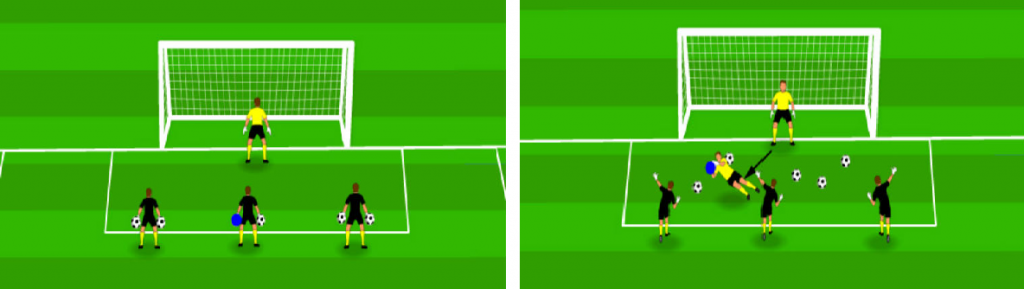
- On the coach’s signal, the servers randomly throw/toss their soccer balls into the 6-yard area in front of the goal.
- The coach then immediately shouts “go!” or blow his whistle, and the goalie must turn quickly, find the target ball, and dive for the ball.
- Servers collect the soccer balls, and the goalkeeper resets their position by returning to the goal and turning away from the servers.
- As soon as the players and soccer balls are reset, repeat the process 4-6 more times before resting or rotating the next goalkeeper.
- Each goalkeeper should complete at least 10-12 repetitions or 2-3 rounds.
It develops a goalkeeper’s vision and reaction time. Goalkeepers improve their footwork and agility as well as they move to attack the target ball.
Goalkeeper Reaction
A goalkeeper must react to two attacking players running behind mannequin defenders. The goal here is to receive the ball from the passer and score.
The goalkeeper is unaware of which attacking player will be passed to and must move to quickly close them down and make a save on their close-range shot.
Setup:
- Place three mannequins, flags, or cones 1-3 yards outside of the penalty box. They should be placed parallel to the penalty box line with 5-7 yards between each one.
- Place one cone 10-12 yards directly above each mannequin. These cones will the starting points for the three attackers.
- A full-size goal is needed on the end line of the penalty area.
- One goalkeeper is positioned in a goal. If there are extra goalkeepers, have them stand to the goal’s side and rotate every 1-2 repetitions.
- At least three extra players are needed as the attackers in this activity. If there are more than three attackers, have them form lines behind the cones and rotate after each repetition. It is best if the attackers are field players.
- Place 4-6 soccer balls with the attacker on the center cone.
- One attacker starts behind each of the three cones. The attacking player on the center cone begins with a ball at their feet.
Variation:
- If there are more attacking players, add another attacker to make the goalkeeper react to another attacking position.
- To keep the goalkeepers honest, tell the attacking player who dribbles towards the mannequins to take a long-range shot. This is better passing the ball to another attacker if they see the goalkeeper is out of position.
Execution:
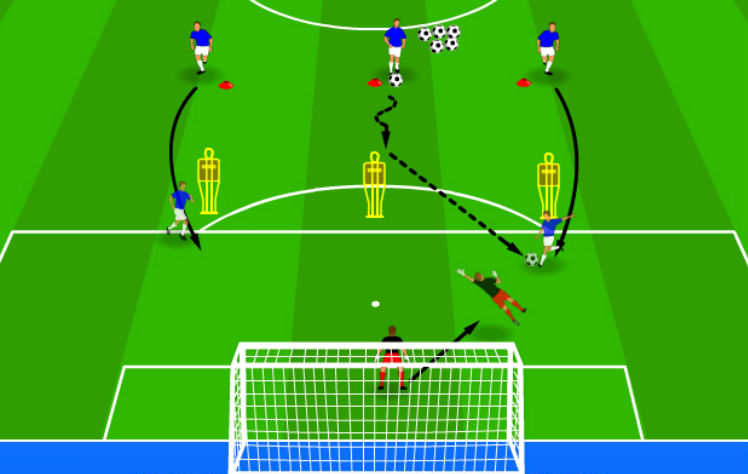
- To start, the attacking player with the ball dribbles towards the mannequins. The goalkeeper positions in front of their goal for a long-range shot or a through ball behind their defense.
- The attackers on the wings who don’t have the ball will run to outside mannequins. They will set themselves up to receive a through ball behind the mannequins.
- The attacker with the ball passes to one of the two attackers running behind the mannequins.
- The goalkeeper immediately moves while the ball is traveling towards the attacking player. This is an attempt to cut off the scoring angles and get as big as possible.
- The attacking player takes a 1-touch shot or attempts to receive the pass and dribble around the goalkeeper.
- The goalkeeper reacts to the attacker’s choice and attempts to make a save on the ball.
- The attacking player who receives the through ball cannot use the other two attackers when attempting to score.
- The attacking players should time their runs to stay onside and make the activity more realistic.
- After a save or a goal, the players and goalkeeper reset and repeat the process as soon as they are ready. If there are extra goalkeepers, have them rotate after 1-2 repetitions. If there are additional attacking players, have them alternate after every repetition.
- The activity continues until each goalkeeper has completed at least 7-10 repetitions.
It helps develop a goalkeepers’ positioning, quick decision making, and shot-stopping. Attackers improve the 1-on-1 finishing abilities with a live goalkeeper and the timing of their runs and first touch.
Migrated from the original Goalies Club football site. Expert review pending under our editorial policy. Spotted an error? Tell us.