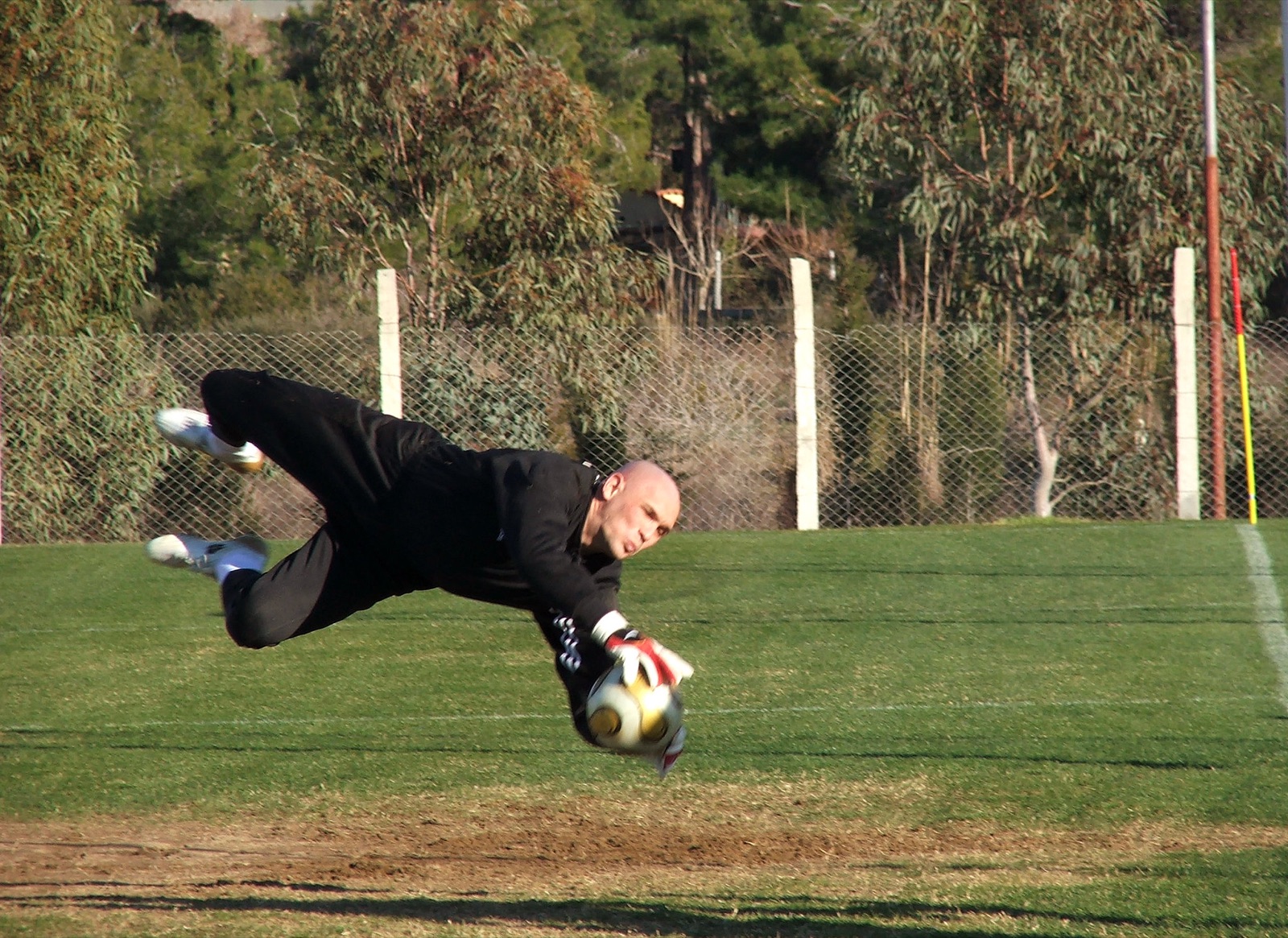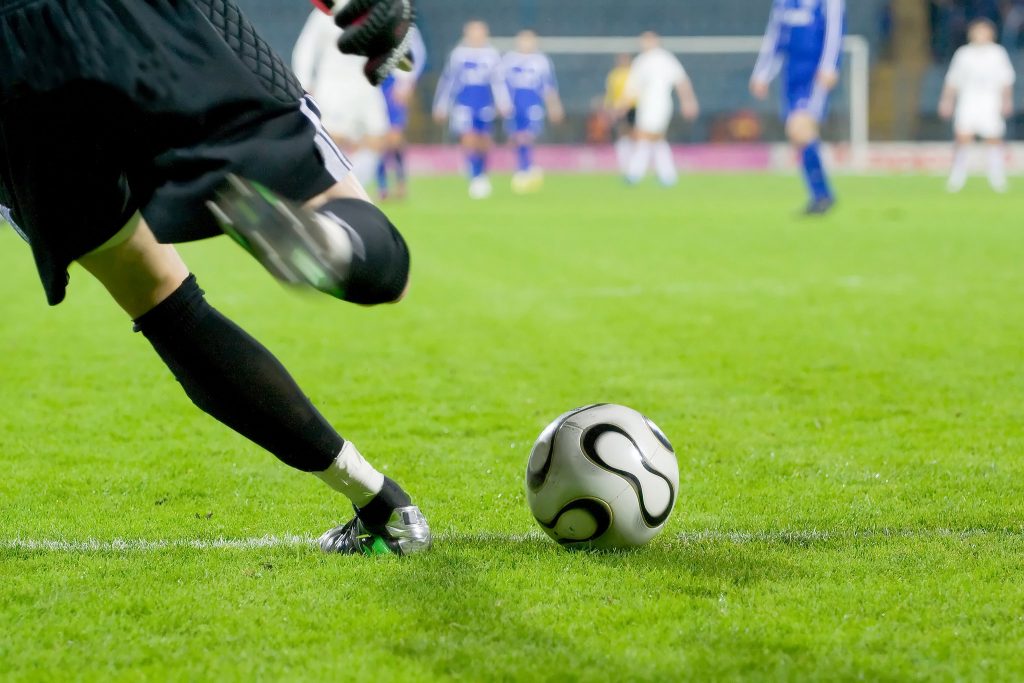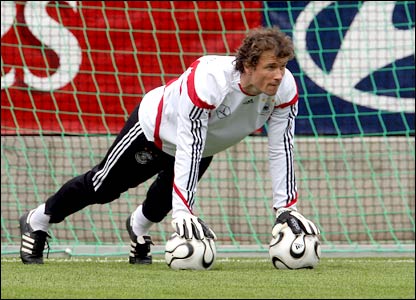
One of the many outdated ideas in football (soccer) culture is to place the tallest player on the team in the goal. This thinking diffused soccer fields in decades past.
But as soccer exploded across the globe and more and more athletes joined the game, the tallest athlete is no longer the only goalie crossing the eighteen-yard box.
Today’s keepers come in different shapes and sizes. But what elite level keepers have in common is a tremendous athletic ability. No matter how tall a person may be, what will set them apart in the goal is their agility, power, and strength.
Any goalie will show you that it is not the high shot that is the toughest to save. It is the knee-high blast to a corner, where quickness and explosiveness come into play.
These features, quickness, explosiveness, and strength that coaches are looking for out in their keepers.
To reach this superior, training and conditioning must be emphasized. While keepers do not do a considerable amount of running on the field, they are the player that has to be the most trained and focused.
When fitness is lacking, physical and mental mistakes happen. During this time, a gamekeeper has to be constantly linked. Placing themselves and their defense and instantly ready to save when the opponent is in their end of the field.
This demands a goalie to be in top shape and as explosive as possible.
A keeper must have enough stamina to stay mentally concentrated in the final minute of a game to come up with the game-winning save.
The time to train and make gains in speed, power, and strength is during the off-season and pre-season. For many soccer players, this is a hard time to identify many plays due to the year-round schedules.
Usually, the offseason falls over the winter when there are fewer games and practices. And the pre-season comes to a couple of months before the primary competitive season begins.
Taking steps to condition during these times will help prepare a goalie for the rigors of an upcoming season and prevent injuries. Strength, agility, and plyometric (Jump) training should occur two to three times a week during these periods.
Throughout a player’s primary competitive season, depending on their schedule’s demands, it is a good idea to condition one day a week to maintain strength and power.
It is always recommended to work with a trainer or at a strength and conditioning facility to ensure that exercises are done with proper technique, especially strength and plyometric training. If you can’t find any way to get to a trainer, don’t be put off if. There are ways to train on your own effectively.
Below is a sample workout that focuses on agility, power, and strength. This can be done on your own and will help any goalkeeper increase their conditioning and explosiveness. Alternate between the two days to keep workouts fresh and to cover all areas of fitness.
I’ve also created a table of contents to make your browsing easy.
Ball Stretches
Push-ups
Push-ups on Ball
Abdominal Workout
Plyometric Workout
Highballs from a seated position
Highballs
Post-to-Post Shuffles
Post-to-Post Low Diving
Alternate crossbar touches
Alternate crossbar touches (different variation)
Scoops with forwarding Dive
Scoops (under pressure)
Goalkeeper Cone Sprints
Ball Stretches
Stand with your feet 2 to 3 yards apart. Roll the ball in a figure-8 around and through your legs slowly, pausing to stretch in each position necessary. Reach the ball as far back behind your legs as you can and hold the stretch. Add any other stretch you feel necessary.
Push-ups
Do in sets of 10 to 15 sets with a gradual increase in repetitions depending on the week.
- 20 repetitions – Weeks 1, 2
- 30 repetitions – Weeks 3, 4
- 35 repetitions – Weeks 5, 6
- 40 repetitions – Weeks 7, 8
- 45 repetitions – Weeks 9, 10, 11
Push-ups on Ball
Do in sets of 5 to 10 sets with a gradual increase in repetitions depending on the week.
- 5 repetitions – Weeks 1, 2
- 10 repetitions – Weeks 3, 4
- 15 repetitions – Weeks 5, 6
- 20 repetitions – Weeks 7, 8
- 25 repetitions – Weeks 9, 10, 11
You can do these with your knees on the ground if you can’t do them in a regular push-up position, but double the repetition required.
Abdominal Workout
Core stabilizing workouts train the lower back to be stable, protecting the health of the spine.
Also, they correctly train the core to act as a part of many muscle groups. This includes the hips, low back, abdominals, and obliques must work together to efficiently achieve actions such as:
- Control stability on the plant foot when shooting a ball
- Manage their balance when faking left or right against a defender
- Shoot without putting stress on the low back
- Move the hip extensors (during the back-swing) and hip flexors and quadriceps (during the follow-through motion) on powerful shots
- Play with good posture so they can run at high speeds and change direction quicker
- Breathe more efficiently, which helps with recovering after high bouts of intense movement
Variation 1:
Do this for 2 to 3 sets of 10 to 15 repetitions
- Lift your head and shoulders off the ground and hold your chin tucked in.
- Extend your arms and legs together, and do not let your feet touch the ground.
- Inhale through your nose, lower your legs in a controlled manner while exhaling through your nose.
Variation 2:
Do this for 2 to 3 sets of 8 to 10 repetitions on each side
Get in a plank form and line your shoulders up with your hands. Hold your hips from swaying as you touch the opposite hand to the opposite knee.
Variation 3:
Set up in a side plank position with your body straight and hips lined up with your shoulders. Raise the leg and keep your hips in a stationary position. Engage the glutes throughout the movement.
Plyometric Workout
Line up ten cones about a yard and a half apart. Do ten sets of each variation. Try to set a rhythm by not stopping your momentum.
- Forward jumps – feet together (don’t allow your legs to come apart)
- Backward jumps – feet together (don’t allow your legs to come apart – takes practice)
- Side jumps – feet together
- Forward jumps (singles) – 10 sets on each foot
- Backward jumps (singles) – 10 sets on each foot
- Side jumps (singles) – jump off foot nearer to the ball and land on that same foot only. Do not land on the other foot. Ten sets on each foot
Highballs from a seated position
Do this for 5 minutes, with 30 seconds rest in the middle.
Take a seat and throw the ball as high up in the air as you can. Get up as fast as you can and catch the ball as high as you can also.
Use proper highball technique as if you were under pressure and not let the ball come down to you. Jump up as high as you can to catch the ball
Highballs
Do this for 5 minutes, with 30 seconds rest in the middle.
Throw the ball up in the air high. Jump off one foot and reach with both hands over and catch the ball at the highest point you can reach.
Imagine you are under pressure like a corner kick situation. Alternate which leg you jump off.
Post-to-Post Shuffles
Do this for 5 minutes, with 30 seconds rest in the middle.
Begin from the left post and shuffle along an arc to the right post and back. Keep moving for the full two minutes.
The arc should be so that you start at the post, but as you get to the midpoint of the goal, you are about two steps from the goalline and then back to the other post.
Your shoulders, hips, and head should always face the field (ie, the perpendicular of the arc) in a ready position.
Post-to-Post Low Diving
Do this for 5 minutes to 10 from each side, with 30-second rest in the middle.
Put a ball at each post, one yard off the goal line. Start at one post in a push-up position. Once you are established, get up and shuffle over to the other post and low dive through the ball.
Put the ball back down in its original position, return to push-up position. Get up, shuffle, and dive for the other ball.
Repeat either ten times or two minutes (whichever is longer).
By diving through the ball, I mean that your drive should not be so that you can barely get to the ball in full extension.
It would help if you outlined your dive so that you catch or parry the ball a foot past the post. Your momentum should do this for you.
Alternate crossbar touches
Do this for 5 minutes, with 30-second rest in the middle.
Hold the ball above your head as far as you can reach. Stand a yard off the goal line.
Jump off one foot as if you were stretching for a high ball under pressure and touch the ball on the crossbar as high as you can. If you are a good jumper, try to touch the ball on the crossbar’s top side.
Substitute which leg you jump off of each time. Remember, in a game, you will have to jump off each one, depending on your proximity to the goal.
Alternate crossbar touches (different variation)
Do this for 5 minutes, with 30-second rest in the middle.
This time without the ball, jump off one leg and stretch up with the opposite hand and touch the crossbar as high as you can. Alternate which leg you jump off and which hand touches the crossbar.
Scoops (under pressure)
Do this for 5 minutes, with 30-second rest in the middle.
Place a ball about five yards away from you. Run a full speed going for the ball, scoop it up and veer to one side.
Imagine an onrushing attacker. Alternate sides that you veer off to.
Scoops with forwarding Dive
Do this for 5 minutes, with 30-second rest in the middle.
Follow the same routine as the previous drill. This time as you veer off to either side, forward dive onto your forearms with the ball tucked safely between your chest and your forearms.
Do not drive onto the ball as it will probably knock the wind out of you. The technique is essential. Concentrate hard until you develop a good rhythm and technique.
Goalkeeper Cone Sprints
This drill is not only for speed but for footwork as well. Do this ten times from each post, both variations.
Concentrate on going as fast as you can but also try to maintain the same footwork as you progress through each sprint.
Time your sprints. Variation 1 should be within 10 seconds, variation two within 8 seconds. Try to get faster each sprint.
Variation 1:
At one post, sprint to the other post with your body still facing the field (ie, like shuffles).
Touch the post and charge to the opposite ball as if you were defending a breakaway (hands as low as possible). Sprint to another ball while facing the field.
Now go from the ball to the opposite post applying a backward cross-over step as if you were trying to swerve a highball over the crossbar.
Variation 2:
Begin from one post, attack the ball as if you were defending a breakaway (hands as low as possible).
Run from the ball to the opposite post using the backward crossover step as if you were going to deflect a highball over the crossbar.
Immediately attack the next ball as if you were defending a breakaway. Go from the ball to the opposite post doing a backward crossover step.
Final Thoughts
Keepers can come in various shapes and sizes. But what top-level goalies have in common is a tremendous athletic skill.
Goalkeepers can make gains in pace, agility, and strength. This is possible by shifting between different training exercises.
This also keeps workouts fresh. That’s because it focuses on footwork, handling technique, mental sharpness or alertness, agility, and physical fitness.
Migrated from the original Goalies Club football site. Expert review pending under our editorial policy. Spotted an error? Tell us.